
SEO vs AEO: What Shopify Store Owners Need to Know in 2026
Published: January 2025 | Reading Time: 10 minutes | Author: Robert Rose
The way people shop online has fundamentally changed.
In 2020, customers typed "best organic shampoo UK" into Google and clicked through 10 blue links.
In 2025, they ask ChatGPT: "What's the best sulfate-free shampoo for 4C hair that ships to London?" and get 3 specific recommendations in 30 seconds.
This shift represents a £2.3 trillion opportunity as AI-assisted commerce is projected to account for 40% of all online purchases by 2027.
If you're only doing SEO, you're missing half the market.
Let me show you exactly what's changed, what still works, and how to win at both.
What's Actually Changed (The Short Version)
Traditional SEO (2010-2023)
How it worked:
Customer searches "organic baby shampoo"
Google shows 10 websites
Customer clicks 3-4 links
Compares options
Makes a decision after 20+ minutes
Your goal: Rank on page 1 of Google
AEO - AI Engine Optimisation (2024+)
How it works:
Customer asks AI: "I need a gentle shampoo for my baby with eczema-prone skin, organic ingredients only, ships to Manchester"
AI provides 3 specific recommendations with reasoning
Customer clicks directly to the product
Purchase decision in 5 minutes
Your goal: Be one of the 3 AI-recommended options
SEO vs AEO: The Complete Comparison
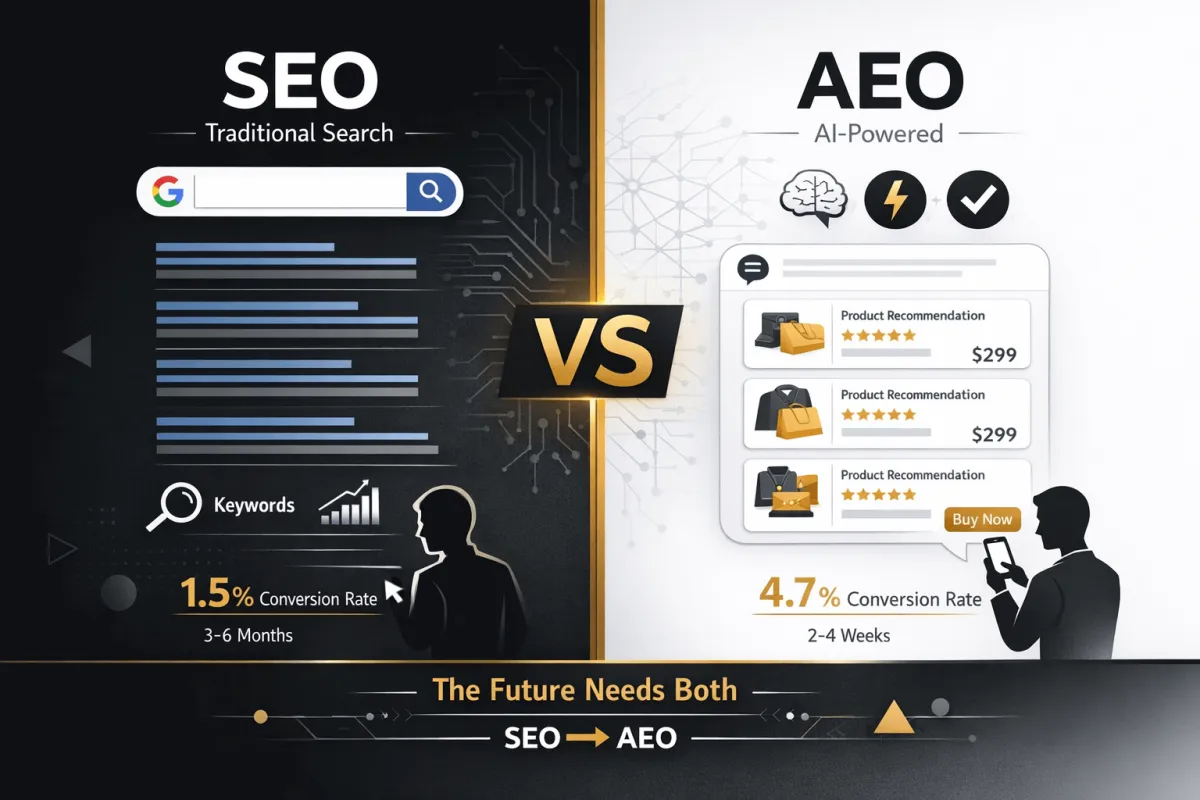
Aspect SEO AEO Primary Platform Google Search ChatGPT, Claude, Perplexity User Intent Information seeking Solution seeking Competition 10 results per page 3-5 recommendations Content Style Keyword-optimized Conversational, natural Success Metric Rankings, traffic AI mentions, referrals Conversion Rate 1.5-2.5% average 4-7% average Speed to Results 3-6 months 2-4 weeks Cost £500-2,000/month £300-800/month Sustainability Long-term if maintained Growing rapidly
Why You Need BOTH (Not One or the Other)
Here's what most people get wrong: SEO and AEO aren't competitors. They're complementary.
Think of it like this:
SEO = Top of Funnel (Discovery)
The customer doesn't know you exist yet
They're researching options
Building awareness
Long-term traffic source
AEO = Bottom of Funnel (Conversion)
Customer knows what they need
Ready to make a decision
High purchase intent
Immediate sales
Real Example from Black Hair Care UK:
Before (SEO Only):
3,200 monthly visitors from SEO
2.1% conversion rate
67 orders
£4,355 monthly revenue from SEO
After (SEO + AEO):
3,400 monthly visitors from SEO (↑ 6%)
2.3% conversion rate from SEO
78 orders from SEO
+ 847 visitors from AI referrals
7.2% conversion rate from AI
61 orders from AI referrals
Total: 139 orders, £9,027 monthly revenue (↑107%)
The SEO traffic grew slightly, but adding AEO doubled total revenue.
What Still Works in SEO (2025 Edition)
Don't abandon SEO. But focus on what actually matters now:
1. Technical SEO Fundamentals
These will always matter:
Essential Technical Elements:
Mobile-friendly (60%+ of traffic)
Fast loading speed (<3 seconds)
HTTPS security
Clean URL structure
XML sitemap
Proper redirects
Schema markup (helps both SEO and AEO)
Check Your Technical SEO:
Use Google PageSpeed Insights
Run Mobile-Friendly Test
Check Google Search Console for errors
Fix broken links monthly
2. Content That Answers Questions
Old SEO (2020):
"Best organic shampoo UK natural hair products sulfate-free London Manchester..."
New SEO (2025):
"This organic shampoo is perfect for natural curly hair because it's completely sulfate-free, which means it won't strip your hair's natural oils. Customers with 4C hair love it because..."
The difference: Natural language that actually helps people.
3. Local SEO (If You Have Physical Presence)
Critical for local businesses:
Google Business Profile (complete and updated)
Consistent NAP (Name, Address, Phone)
Local citations
Customer reviews with responses
Location pages for each city you serve
4. Quality Backlinks (Still Matters)
But the strategy has changed:
Old approach: Buy 1,000 directory links. New approach: Get 10 high-authority links from relevant sources
Focus on:
Industry publications
Expert blogs
News mentions
Partnership websites
Supplier/vendor pages
5. User Experience Signals
Google increasingly measures:
Time on site
Bounce rate
Pages per session
Repeat visits
Click-through rate
Translation: If your site sucks, SEO won't save you.
AEO: What You Need to Implement Now
1. Structured Data (Critical)
AI engines prioritise sites with proper schema markup.
Essential Schema Types for Shopify:
{ "@context": "https://schema.org/", "@type": "Product", "name": "Organic Curl Shampoo", "description": "Sulfate-free shampoo for curly hair...", "brand": { "@type": "Brand", "name": "Black Hair Care UK" }, "offers": { "@type": "Offer", "price": "12.99", "priceCurrency": "GBP", "availability": "InStock" }, "aggregateRating": { "@type": "AggregateRating", "ratingValue": "4.8", "reviewCount": "127" }
}
How to add: Use Shopify apps like "SEO Manager" or "JSON-LD for SEO"
2. Natural Language Product Descriptions
Write for how people actually talk:
Bad (keyword-stuffed):
"Organic shampoo best natural shampoo curly hair sulfate free organic natural hair care products UK"
Good (conversational):
"This shampoo is perfect for curly hair because it's sulfate-free, which means it cleans without stripping the natural oils your curls need. Parents love it for their children because it's gentle, tear-free, and contains no harsh chemicals."
3. Comprehensive Product Information
AI engines prefer complete, detailed information:
Minimum per product:
What it is (2-3 sentences)
Who it's for (specific customer profiles)
How to use it (step-by-step)
What results to expect (with timeline)
Full ingredient/material list
Certifications or safety info
Size/quantity details
Care instructions
4. Customer Reviews (Quality Matters)
Not just quantity - AI values detailed, specific reviews:
Generic review (low AI value):
"Great product! 5 stars!"
Detailed review (high AI value):
"Finally found a shampoo that works for my 7-year-old's 4C hair. After 2 months, her hair is noticeably softer, we can brush it without tears, and her eczema patches cleared up. Would definitely recommend to other parents. - Sarah M., Manchester, Verified Purchase"
Action items:
Request detailed reviews in follow-up emails
Ask specific questions in review requests
Respond to all reviews (adds context)
Feature the best reviews on product pages
5. Real-Time Data Feeds
Keep information current:
Inventory status (in stock / low stock / out of stock)
Current pricing
Shipping availability
Product variations available
Promotional periods
Why it matters: AI engines penalise outdated information.
Your Integrated SEO + AEO Strategy
Month 1: Foundation
Week 1: Technical Audit
[ ] Run site speed test
[ ] Check mobile responsiveness
[ ] Review Google Search Console errors
[ ] Fix critical technical issues
Week 2: Content Audit
[ ] Review top 20 product descriptions
[ ] Identify keyword-stuffed content
[ ] List products needing better descriptions
Week 3: Implement Structured Data
[ ] Install schema markup app
[ ] Add product schema to the top 10 products
[ ] Verify with Google's Rich Results Test
Week 4: Review Strategy
[ ] Set up automated review requests
[ ] Respond to existing reviews
[ ] Create review collection incentives
Month 2: Content Optimisation
SEO Content:
Rewrite the top 20 product descriptions (natural language)
Create category pages with helpful content
Build "Complete Guide" blog posts
Add FAQ sections to main pages
AEO Content:
Expand product descriptions (answer all questions)
Add use cases and examples
Include "Who this is for" sections
Create comparison content
Month 3: Link Building + Authority
SEO Links:
Guest post on 3 industry blogs
Get mentioned in expert roundups
Partner with complementary brands
Submit to relevant directories
AEO Entity Building:
Complete Google Business Profile
Claim Wikidata entry (if applicable)
List in Crunchbase
Update social profiles consistently
Ongoing: Optimise and Scale
Weekly:
Review analytics (both SEO and AEO traffic)
Respond to new reviews
Update out-of-stock products
Monitor competitor activity
Monthly:
Expand optimised products (add 10 more)
Publish 1-2 blog posts
Check rankings and AI mentions
Adjust strategy based on data
Measuring Success: Dual Tracking
SEO Metrics
Track in Google Analytics / Search Console:
Organic traffic
Keyword rankings (top 20 products)
Impressions and CTR
Backlink growth
Domain authority
Goals:
Month 3: 20% traffic increase
Month 6: 40% traffic increase
Month 12: 100% traffic increase
AEO Metrics
Track Manually + Analytics:
AI mentions (test ChatGPT, Claude, Perplexity weekly)
AI referral traffic (UTM tags)
AI conversion rate
Revenue from AI sources
Goals:
Month 1: 5-10 AI mentions
Month 3: 20-30 AI mentions
Month 6: 50+ AI mentions
Combined Business Metrics
What actually matters:
Total traffic (all sources)
Total revenue
Customer acquisition cost
Return on investment
Customer lifetime value
Budget Allocation: SEO vs AEO
Small Store (£25K-75K monthly)
Total Marketing Budget: £500-1,000/month
Recommended Split:
40% SEO (£200-400): Technical optimisation, content creation
40% AEO (£200-400): Structured data, review collection, AI chatbot
20% Testing (£100-200): New channels, experiments
Medium Store (£75K-200K monthly)
Total Marketing Budget: £1,500-3,000/month
Recommended Split:
35% SEO (£525-1,050): Advanced SEO, link building, content marketing
45% AEO (£675-1,350): Full AI implementation, multi-channel optimisation
20% Testing (£300-600): Advanced strategies, new platforms
Large Store (£200K+ monthly)
Total Marketing Budget: £3,000-10,000/month
Recommended Split:
30% SEO (£900-3,000): Comprehensive SEO program
50% AEO (£1,500-5,000): Custom AI solutions, full automation
20% Testing (£600-2,000): Cutting-edge strategies
Common Questions Answered
Q: Should I stop doing SEO and focus only on AEO?
A: No! SEO still drives discovery and long-term traffic. AEO captures high-intent buyers. You need both.
Q: How long does AEO take to show results?
A: 2-4 weeks typically. Much faster than SEO (3-6 months) because AI systems update more frequently.
Q: Is AEO more important than SEO now?
A: For immediate revenue, yes. For long-term sustainable growth, no. They serve different purposes.
Q: Can I do AEO myself, or do I need an expert?
A: Basic AEO (content optimisation, reviews) you can do yourself. Advanced AEO (structured data, API integrations) benefits from expertise.
Q: What if AI doesn't recommend my products?
A: This is why early adoption matters. Build your entity authority and optimise content now before competitors catch on.
Q: Will SEO become obsolete?
A: No. But it's evolving. Voice search, AI assistants, and natural language are the future. Traditional keyword SEO is declining.
Your 90-Day Action Plan
Month 1: Foundation
Complete technical SEO audit and fixes
Implement structured data on your top products
Rewrite the top 20 product descriptions
Set up a review collection system
Month 2: Content & Authority
Create 4 comprehensive blog posts
Build 5-10 quality backlinks
Optimise all product categories
Expand structured data to all products
Month 3: Scale & Optimise
Analyse what's working (SEO vs AEO)
Double down on successful strategies
Expand to more products
Test advanced tactics
Expected Results:
SEO: 15-25% traffic increase
AEO: 20-40 AI mentions
Combined: 25-40% revenue increase
Get Expert Help with Your Strategy
Balancing SEO and AEO requires expertise in both traditional optimisation and cutting-edge AI strategies.
The 5-Pillar AI Revenue Machine includes:
Complete SEO audit and optimisation
Full AEO implementation
Integrated strategy for maximum ROI
Ongoing optimisation for both
Guaranteed revenue increase
Book Your Free AI Readiness Assessment
We'll analyse:
Your current SEO performance
Your AI visibility (or lack thereof)
Biggest opportunities for growth
Personalised strategy roadmap
Limited to 5 Assessments Per Month
Last Updated: January 2025
Related Articles:


