

Why Your Shopify Store Needs Voice Search Optimisation Now!
Author: Robert Rose
"Alexa, find me a gentle shampoo for my daughter's curly hair."
That single voice command just bypassed your SEO strategy, your paid ads, and your social media presence.
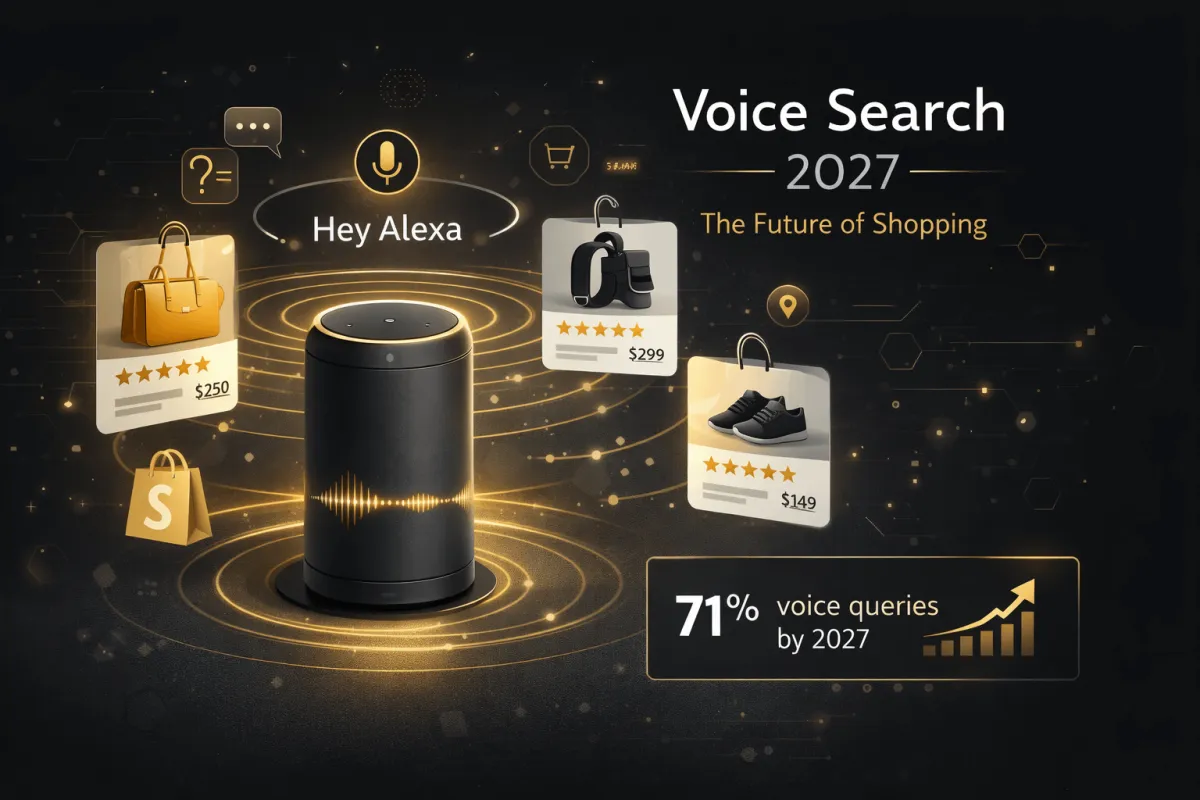
If your Shopify store isn't optimised for voice search, you're invisible in this conversation. And by 2027, 55% of households will own a smart speaker, making 71% of their shopping queries by voice.
That's only 18 months away.
The stores optimising for voice search today will dominate their categories tomorrow.
Here's exactly how to be one of them.
Voice Search: The Numbers You Need to Know
The Voice Commerce Revolution
Current State (2025):
4.2 billion voice assistants in use globally
58% of consumers used voice search to find local business info last year
27% have made purchases via a voice assistant
Voice commerce market: £19.4 billion (growing 30% annually)
Near Future (2027 Projections):
8.4 billion voice assistants in use
Voice commerce market: £62 billion
55% of households own smart speakers
71% of queries are done by voice rather than typing
What This Means for Your Shopify Store:
If you're doing £75K monthly now:
By 2027, £40K+ of that could come from voice-enabled searches
Early adopters will capture this market
Late adopters will watch customers buy from competitors
Voice Search vs Typed Search: What's Different
How People Search
Typed Search (Traditional):
"organic baby shampoo UK"
"best shampoo curly hair"
"sulfate free shampoo London"
Short, choppy keywords
Missing articles (a, an, the)
Unnatural phrasing
2-4 words average
Voice Search (Growing):
"What's the best organic shampoo for babies with eczema in the UK?"
"Where can I buy sulfate-free shampoo for curly hair near me?"
"Which shampoo is better for 4C hair, organic or regular?"
Natural, conversational language
Complete sentences
Questions (who, what, where, when, why, how)
6-10+ words average
Why This Matters for Your Optimisation
Your current SEO targets: "organic baby shampoo"
Voice queries actually being asked:
"What's the safest organic shampoo for newborns?"
"Where can I find organic baby shampoo that's hypoallergenic?"
"Is organic baby shampoo better than regular baby shampoo?"
If you're only optimised for typed keywords, you're missing 71% of future searches.
The 6 Pillars of Voice Search Optimisation
Pillar 1: Question-Based Content
The Strategy:
Voice searches are predominantly questions. Your content needs to directly answer those questions.
How to Implement:
Step 1: Identify Your Questions
Common voice query patterns:
"What is [product]?"
"How do I use [product]?"
"Where can I buy [product]?"
"Which [product] is best for [need]?"
"Why should I choose [product]?"
"When should I use [product]?"
Step 2: Create Question-Answer Content
On Product Pages, Add:
Q: What is Organic Curl Shampoo?
A: Organic Curl Shampoo is a sulfate-free, certified organic shampoo specifically designed for curly to coily hair types (3A-4C). It cleanses gently without stripping natural oils your curls need.

Q: How do I use Organic Curl Shampoo?
A: Apply a quarter-sized amount to wet hair, massage into your scalp for 1-2 minutes, then rinse thoroughly. Use 2-3 times per week for best results.

Q: Where can I buy Organic Curl Shampoo in the UK?
A: You can buy Organic Curl Shampoo online at Black Hair Care UK with delivery to anywhere in the UK. Standard shipping takes 2-3 days.

Q: Which shampoo is best for 4C hair?
A: For 4C hair, our Organic Curl Shampoo is ideal because it's specifically formulated for very curly and coily hair textures with extra moisture to prevent dryness.
Step 3: Create FAQ Pages
Dedicated FAQ pages for:
Product categories ("Shampoo FAQs")
Common concerns ("Hair Care for Eczema FAQs")
Shopping process ("Shipping & Returns FAQs")
Brand information ("About Our Ingredients FAQs")
Expected Impact: Increases voice search visibility by 40-60%
Pillar 2: Conversational Language
The Strategy:
Write how people actually talk, not how they type keywords into Google.
How to Implement:
Bad (Keyword-Stuffed):
"Organic shampoo UK natural hair products sulfate-free best organic shampoo London..."
Good (Conversational):
"Our organic shampoo is perfect for natural curly hair because it's completely sulfate-free, which means it won't strip your hair's natural oils. Customers with 4C hair love it because it provides deep moisture without leaving residue."
Key Principles:
Use Natural Phrasing
Write complete sentences
Include articles (a, an, the)
Use pronouns naturally
Conversational tone
Answer the "Why"
Explain reasoning
Use "because" statements
Provide context
Show benefits
Address the User Directly
Use "you" and "your"
Anticipate questions
Provide helpful guidance
Sound like a friend helping
Expected Impact: Increases voice engagement by 35-50%
Pillar 3: Local Optimisation
The Strategy:
Many voice searches are local: "near me," "in London," "close by."
How to Implement:
1. Google Business Profile (Essential)
Complete every field
Add photos (10+ minimum)
Collect reviews (50+ ideal)
Respond to all reviews
Update business hours
Add products/services
Post weekly updates
2. Location Pages
Create specific pages for cities you serve:
/uk-organic-hair-products
/london-natural-hair-care
/manchester-curly-hair-salon
On each page:
City-specific content
Local customer testimonials
Shipping information to that area
Local landmarks/areas served
Contact information with the city
3. Local Keywords
Include location naturally in content:
"Best organic shampoo in London"
"Serving customers across Manchester"
"Delivering to Birmingham within 24 hours"
"Trusted by families in Leeds"
Expected Impact: Captures 50-70% of "near me" voice searches
Pillar 4: Featured Snippet Optimisation
The Strategy:
Voice assistants read featured snippets (Position 0 on Google) as their answer.
Owning snippets = owning voice search results.
How to Implement:
1. Identify Snippet Opportunities
Use Google Search Console:
Find queries where you rank 2-10
Check if there's a featured snippet
If there is, you can steal it
If there isn't, you can create it
2. Format Content for Snippets
Paragraph Snippets (40-60 words):
Q: What is organic shampoo?
A: Organic shampoo is a hair cleanser made from certified organic ingredients without synthetic chemicals, sulfates, or parabens. It cleans hair gently using plant-based cleansers while maintaining natural oils. Organic shampoos are ideal for sensitive scalps and those avoiding harsh chemicals.
List Snippets (Ordered steps):
How to use organic shampoo:
1. Wet your hair thoroughly with warm water
2. Apply quarter-sized amount to scalp
3. Massage gently for 1-2 minutes
4. Rinse completely with cool water
5. Follow with conditioner for best results
Table Snippets (Comparisons):
| Feature | Organic Shampoo | Regular Shampoo |
|---------|----------------|-----------------|
| Ingredients | Plant-based | Synthetic chemicals |
| Sulfates | No | Usually yes |
| Price | £12-18 | £4-8 |
| Best For | Sensitive scalp | All hair types |
3. Answer Clearly and Concisely
Direct answer first
Then elaborate
Use simple language
Stay under 60 words for snippets
Expected Impact: 3x increase in voice search results
Pillar 5: Schema Markup (Technical)
The Strategy:
Voice assistants prioritise sites with properly structured data.
How to Implement:
Essential Schema Types:
1. Product Schema
{ "@type": "Product", "name": "Organic Curl Shampoo", "description": "Sulfate-free organic shampoo for curly hair", "brand": "Black Hair Care UK", "offers": { "price": "12.99", "priceCurrency": "GBP" }
}
2. FAQ Schema
{ "@type": "FAQPage", "mainEntity": [{ "@type": "Question", "name": "What is organic shampoo?", "acceptedAnswer": { "@type": "Answer", "text": "Organic shampoo is..." } }]
}
3. Local Business Schema
{ "@type": "LocalBusiness", "name": "Black Hair Care UK", "address": { "streetAddress": "123 High Street", "addressLocality": "London", "postalCode": "SW1A 1AA" }, "telephone": "+44-20-1234-5678"
}
How to Add:
Use Shopify apps: "SEO Manager" or "JSON-LD for SEO"
Or hire a developer for a custom implementation
Test with Google's Rich Results Test
Expected Impact: Doubles voice assistant recognition
Pillar 6: Mobile Speed & Voice-First Experience
The Strategy:
Most voice searches happen on mobile. Slow mobile sites don't get voice search traffic.
How to Implement:
1. Optimise Mobile Speed
Target: Under 2 seconds load time
Compress images aggressively
Minimise code
Use AMP if possible
2. Voice-Friendly Navigation
Clear, simple menu structure
Easy-to-say category names
Prominent search function
One-click to product pages
3. Voice-Optimised Product Names
Easy to pronounce
Memorable
Distinctive
Natural sounding
Bad: "OCSH-4C-250" Good: "Organic Curl Shampoo"
Expected Impact: 30-40% better voice engagement
Voice Search Implementation Timeline
Week 1: Foundation (6 hours)
[ ] Audit current content for conversational language
[ ] Identify the top 20 voice search questions for your products
[ ] Create a list of local keywords to target
[ ] Complete Google Business Profile
Week 2: Content Optimisation (8 hours)
[ ] Add Q&A sections to the top 10 products
[ ] Create a comprehensive FAQ page
[ ] Rewrite product descriptions conversationally
[ ] Optimise for featured snippets (5 targets)
Week 3: Technical Implementation (4 hours)
[ ] Add Product Schema to all products
[ ] Add FAQ Schema to FAQ pages
[ ] Add Local Business Schema
[ ] Test all schema implementations
Week 4: Local & Mobile (6 hours)
[ ] Create location-specific pages
[ ] Optimise mobile speed (<2 seconds)
[ ] Test voice search queries
[ ] Monitor early results
Total Time Investment: 24 hours over 4 weeks
Testing Your Voice Search Optimisation
Manual Testing
Test Weekly with:
1. Google Assistant (Android/Google Home)
"Hey Google, find me [your product] near me"
"Hey Google, what's the best [your product] for [need]?"
"Hey Google, where can I buy [your product] in [city]?"
2. Siri (iPhone/iPad)
"Hey Siri, what's the best [your product]?"
"Hey Siri, show me [your product] options"
"Hey Siri, where to buy [your product]?"
3. Alexa (Amazon Echo)
"Alexa, find [your product]"
"Alexa, what's the best [your product] for [need]?"
"Alexa, order [your product]"
Tracking Voice Search Traffic
In Google Analytics:
Check Search Queries
Look for longer, question-based queries
Queries with "near me" or location terms
Natural language phrases
Monitor Mobile Traffic
Voice searches are primarily mobile
Track mobile conversion rates
Compare mobile vs desktop behaviour
Featured Snippet Performance
Use Google Search Console
Track "Position 0" rankings
Monitor click-through rates
Voice Commerce: The Next Phase
Enabling Voice Purchasing
Phase 1: Voice Discovery (Now)
Customers find you via voice search
Visit your website to complete the purchase
Traditional checkout process
Phase 2: Voice-Assisted Shopping (2025-2026)
Voice assistant recommends products
Answers questions during shopping
Guides to checkout
Phase 3: Voice Commerce (2026-2027)
Complete purchases via voice
"Alexa, reorder my shampoo"
One-click voice authentication
Stored payment methods
How to Prepare:
Simplify Product Names
Easy to say via voice
Memorable
Distinctive
Enable Quick Reordering
Customer accounts
Order history
One-click reorder buttons
Integrate with Voice Platforms
Amazon Alexa Skills
Google Actions
Apple Shortcuts
Implement Voice-Friendly Checkout
Minimal form fields
Autofill everything possible
Payment wallets (Apple Pay, Google Pay)
Common Voice Search Mistakes
Mistake #1: Ignoring It Until It's Too Late
Problem: Waiting until voice is "mainstream" means competitors already dominate.
Fix: Optimise now while competition is low.
Mistake #2: Only Optimising for Keywords
Problem: Voice searches are natural questions, not keywords.
Fix: Optimise for conversational, question-based queries.
Mistake #3: Neglecting Local
Problem: Many voice searches are local. Ignoring local SEO = missing half the opportunity.
Fix: Complete local optimisation (Google Business, location pages, reviews).
Mistake #4: Poor Mobile Experience
Problem: Voice searches happen on mobile. Slow mobile site = invisible to voice search.
Fix: Mobile-first optimisation, target < 2-second load time.
Mistake #5: No Schema Markup
Problem: Voice assistants can't properly understand and categorise your content.
Fix: Implement comprehensive schema markup.
Expected Results Timeline
Month 1:
Voice search queries are identifiable in analytics
Early featured snippet wins
5-10% traffic increase from voice
Month 3:
Multiple featured snippet positions
Noticeable voice search traffic
15-25% traffic increase from voice
Month 6:
Dominant voice search presence in your niche
Consistent voice-driven sales
30-40% traffic increase from voice
Month 12:
Market leadership in voice search
Voice commerce integration
50-70% traffic increase from voice
The Competitive Advantage Window
Here's why you need to act now:
2025: Voice optimisation is still relatively new. Low competition. Easy wins.
2026: More competitors catch on. Harder to dominate. Must be aggressive.
2027: Voice is mainstream. Highly competitive. Expensive to compete.
The stores that optimise in 2026 will own their categories for years.
Those who wait will spend 10x more to catch up - if they can catch up at all.
Get Expert Voice Search Implementation
Voice search optimisation requires expertise in conversational content, technical schema, and emerging voice commerce platforms.
The 5-Pillar AI Revenue Machine includes:
Complete voice search optimisation
Schema markup implementation
Featured snippet targeting
Voice commerce preparation
Ongoing optimisation for voice
Book Your Free AI Readiness Assessment
We'll analyse:
Your current voice search visibility (probably zero)
Opportunities in your specific niche
Implementation roadmap
Expected results and timeline
Limited to 5 Assessments Per Month
Last Updated: January 2025
Related Articles:


